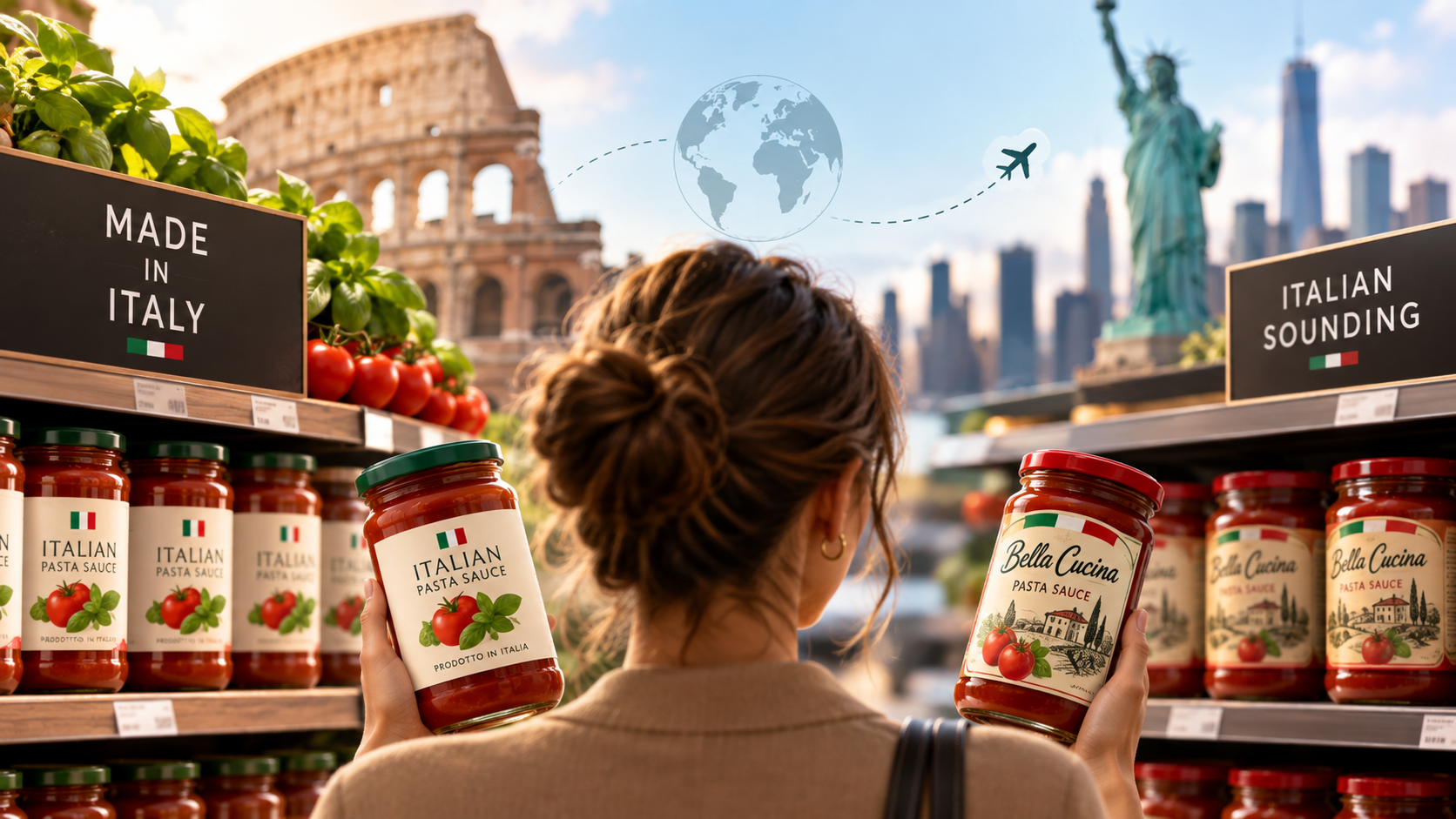
For decades, Made in Italy has been one of the most powerful labels in the global marketplace.
In food, those three words evoke quality, tradition, craftsmanship, authenticity and a culture recognized around the world.
And that reputation still has enormous value.
Italian agri-food exports surpassed €72 billion in 2025, growing 5.6% compared with the previous year. Academic research has also consistently found that consumers associate Made in Italy with higher perceived quality and are willing to pay a premium for it – particularly when it comes to food.
So, if Made in Italy remains so powerful, why ask whether it is still enough?
Because the market around it has changed.
The Italian Premium Is Still Real
Origin matters.
Research into consumer behavior has found a measurable willingness to pay more for Made in Italy products, with food among the categories where the effect is particularly strong.
That gives Italian producers an extraordinary advantage when entering international markets.
But an advantage is not the same as a guarantee.
Today’s consumers are surrounded by products competing on price, convenience, sustainability, health attributes, packaging, innovation and brand identity.
Being Italian can get a product noticed.
It doesn’t automatically get it into the shopping cart.
When Everything Starts to Look Italian
There’s another challenge: Italian is remarkably easy to imitate.
Italian names, colors, imagery and references are widely used around the world on products that have little or no connection with Italy.
This phenomenon – known as Italian Sounding – works precisely because consumers associate Italy with desirable qualities.
Interestingly, research comparing authentic Italian, Italian Sounding and generic foreign food products found that Italian products generated the highest willingness to pay – but Italian Sounding products could still outperform generic foreign alternatives.
That’s an important distinction.
The strength of Italy’s reputation also makes it possible for competitors to borrow some of its appeal.
A tricolor, an Italian-sounding name or an image of the Tuscan countryside can suggest “Italian” in seconds.
Authenticity therefore needs to communicate something deeper.
Consumers Are Buying More Than Origin
Imagine two products sitting next to each other on a supermarket shelf.
One is genuinely Made in Italy.
The other isn’t.
But the second product is cheaper, has attractive packaging, clearly communicates its benefits, fits the consumer’s lifestyle and belongs to a brand they already recognize.
Which one wins?
There is no universal answer – and that’s exactly the point.
Consumers don’t buy countries. They buy products.
Origin can influence the decision, but so can price, taste, ingredients, convenience, sustainability, certifications, packaging, brand recognition and the ability of a product to communicate why it deserves attention.
This is where relying solely on “Made in Italy” becomes risky.
From Origin to Story
For Italian producers, the challenge isn’t to stop talking about where a product comes from.
It’s to explain why that origin matters.
What makes the ingredients different?
What knowledge has been passed down through the company?
What makes the production process distinctive?
Why does a certification matter?
What does the territory actually contribute to the product?
And perhaps most importantly:
Why should a buyer give this product shelf space – and why should a consumer choose it again?
“Made in Italy” becomes much more powerful when it is the beginning of the story rather than the entire story.
Made in Italy Opens the Door. The Product Has to Earn Its Place.
The global success of Italian food shows that Made in Italy has certainly not lost its value.
Quite the opposite.
But international markets are more crowded, consumers have more choices, and competitors have become increasingly sophisticated at communicating quality, authenticity and lifestyle.
For Italian food producers, origin remains an extraordinary competitive asset.
The opportunity now is to build on it.
Because Made in Italy can open the door. But the product still has to earn its place in the market.