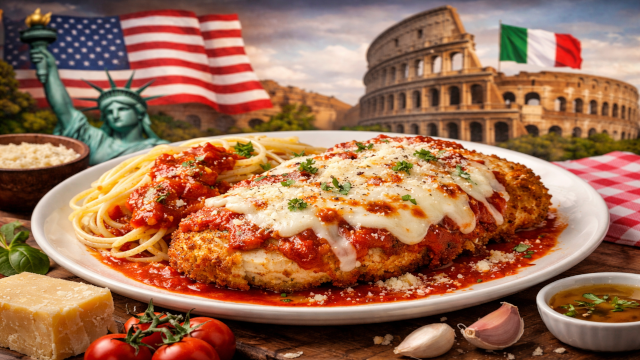
Anyone who has lived in the United States knows this: Chicken Parmesan is one of the most beloved “Italian” dishes in America. Found in nearly every Italian-American restaurant, often served with spaghetti or inside a warm sandwich roll, it has become a symbol of Italian cuisine overseas.
There’s just one small detail.
In Italy, Chicken Parmesan does not exist.
So where did it come from?
Chicken Parmesan, or Chicken Parmigiana, as it is often written in the U.S., was born within Italian-American communities between the late 19th and early 20th centuries, particularly in the Northeastern United States, including New York and New Jersey.
Its roots trace back to a truly Italian dish:
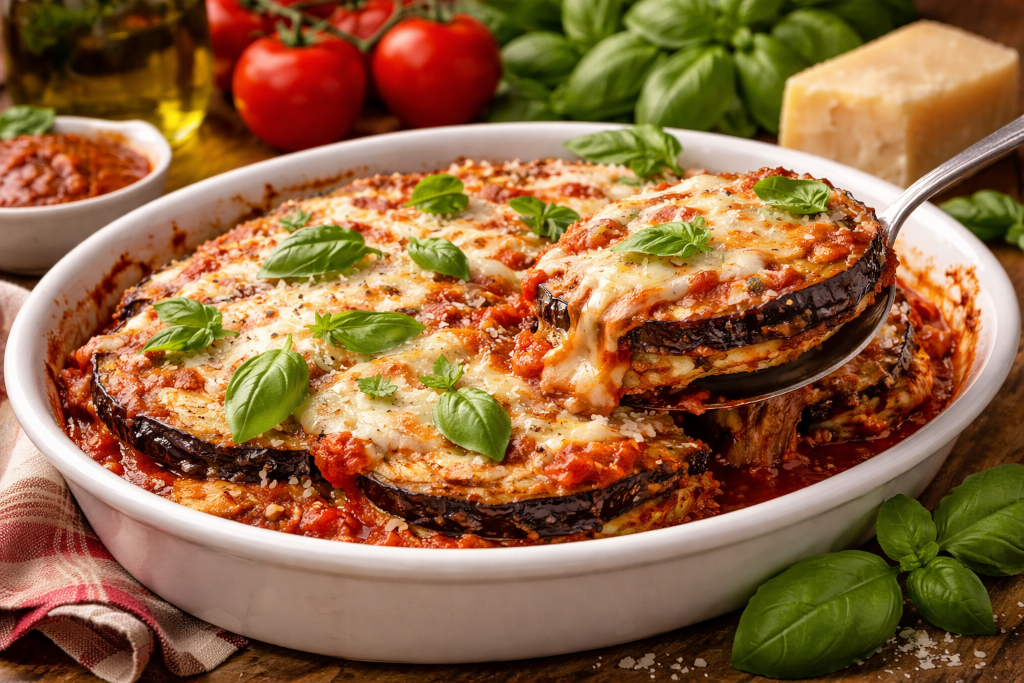
Parmigiana di Melanzane (Eggplant Parmesan).
Italian immigrants, many from Southern Italy, brought with them traditional, simple recipes. The original parmigiana consisted of fried eggplant layered with tomato sauce and cheese.
But once in America, something changed.
Why chicken?
In late 19th-century Italy, meat was often considered a luxury. Chicken was not an everyday ingredient for many families.
In the United States, however:
- Meat was more affordable.
- Portions were larger.
- The food culture favored hearty, protein-rich dishes.
Over time, eggplant was replaced with a breaded and fried chicken cutlet, topped with tomato sauce and melted mozzarella. The result was a richer, more substantial dish — perfectly aligned with American tastes.
And so, Chicken Parmesan was born.
Why is it called “Parmesan”?
The name adds another layer of confusion.
In Italy, “alla parmigiana” does not necessarily mean “with Parmigiano Reggiano.” The term is traditionally linked to the layering technique used in the dish.
In the United States, however, “Parmesan” became directly associated with the cheese itself.
The result is a dish that sounds Italian, looks Italian-inspired, but is fundamentally an Italian-American creation.
Italian or Italian-American?
Chicken Parmesan is a perfect example of Italian-American cuisine: a reinterpretation born from the meeting of Italian culinary tradition and American abundance.
It is not a mistake.
It is not a counterfeit.
It is the natural outcome of cultural integration.
When immigrants adapt their recipes to new environments, they work with available ingredients, economic realities, and local preferences. This process continues today across global markets.
What does this teach us?
Chicken Parmesan tells an important story, especially for Italian companies expanding internationally.
When a product crosses the ocean, it changes.
It adapts.
It evolves.
The challenge is not to prevent evolution, but to guide it strategically.
Understanding the difference between “Italian” and “Italian-inspired” is essential for protecting authenticity, safeguarding geographical indications, and at the same time engaging successfully with international consumers.
Chicken Parmesan is not Italian.
But it is part of the story of Italians in the world.
And perhaps that is exactly what makes it so fascinating.