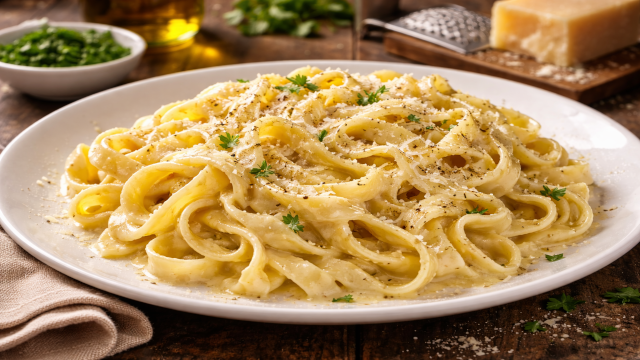
In the United States, Fettuccine Alfredo is one of the most iconic “Italian” pasta dishes.
Rich, creamy, heavy with sauce, often enhanced with chicken or shrimp, it has become a staple of Italian-American restaurants across the country.
But here is the twist.
In Italy, the dish Americans call “Alfredo” does not exist in that form.
The Origins: Rome, early 1900s
Unlike Chicken Parmesan, Alfredo actually has Italian roots.
The dish was created in Rome in the early 20th century by Alfredo Di Lelio, a restaurateur who prepared a simple pasta for his wife after she gave birth. She had lost her appetite, and he wanted something nourishing yet delicate.
The original recipe was extremely simple:
- Fresh fettuccine
- Butter
- Parmigiano Reggiano
That’s it.
No cream.
No garlic.
No chicken.
No shrimp.
In Italy, this preparation is essentially known as “fettuccine al burro”. It is not a national icon and is rarely found as a standard restaurant staple. It is considered a simple, comforting dish.
How did it become “Alfredo”?
In the 1920s, two American silent film stars – Mary Pickford and Douglas Fairbanks, dined at Alfredo’s restaurant in Rome during their honeymoon.
They fell in love with the dish.
When they returned to the United States, they helped popularize it. Alfredo’s restaurant gained international fame, and American tourists began seeking out “Alfredo’s pasta” in Rome.
The name stuck.
But once the dish crossed the Atlantic, it evolved dramatically.

The American transformation
In the United States, the recipe changed to match local tastes and expectations:
- Heavy cream was added.
- Garlic became common.
- Portions became larger.
- Proteins like chicken and shrimp were incorporated.
The result was a thick, creamy sauce – far richer than the original Roman preparation.
What Americans know as “Alfredo sauce” is essentially an Italian-American reinterpretation.
In Italy, asking for “Fettuccine Alfredo” outside of very tourist-oriented areas would likely cause confusion.
Italian or Italian-American?
The American Alfredo is not fake.
It is not wrong.
It is an adaptation.
But it represents something fundamentally different from traditional Italian gastronomy, which often emphasizes simplicity, balance, and ingredient quality over richness and quantity.
Understanding this distinction is essential – especially for Italian companies entering the U.S. market.
Because once a product travels, it rarely remains the same.
A broader lesson
Fettuccine Alfredo, in its American form, does not truly exist in Italy.
Yet its story reflects something deeper: the power of cultural reinterpretation.
For Italian brands expanding abroad, the key question is not whether adaptation will happen.
It will.
The real question is:
Will you control the narrative – or let the market redefine your product for you?