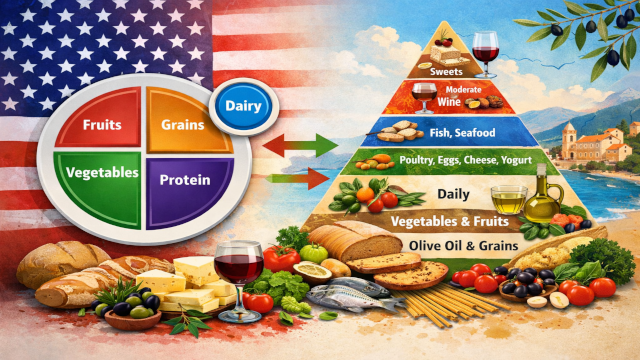
The new U.S. food pyramid and the Mediterranean diet: differences, convergences, and what it means for the American market
For decades, the U.S. Food Pyramid shaped how Americans understood nutrition. Today, however, the traditional pyramid has evolved into a new visual and conceptual framework – MyPlate – reflecting updated scientific research and changing public health priorities.
At the same time, the Mediterranean Diet Pyramid continues to be globally recognized as one of the healthiest dietary models in the world, deeply rooted in Italian food culture.
So how do these two systems compare?
And what does this shift mean for the U.S. market, especially for Italian food and beverage producers looking to expand overseas?
From the U.S. Food Pyramid to MyPlate
The original U.S. Food Pyramid (introduced in 1992) emphasized:
- A high base of grains (6–11 servings per day)
- Moderate consumption of fruits and vegetables
- Limited fats and sweets at the top
Over time, research showed that not all grains and fats are equal, and the model oversimplified complex nutritional realities.
In 2011, the USDA replaced the pyramid with MyPlate, a more intuitive, plate-based model dividing a meal into:
- 50% fruits and vegetables
- 25% grains (with emphasis on whole grains)
- 25% protein
- A side of dairy
The shift reflects several priorities:
- Reducing obesity and metabolic diseases
- Encouraging plant-forward eating
- Promoting portion awareness
- Highlighting whole foods over processed options
This is not just a graphic change, it represents a broader cultural transition in American food habits.
The Mediterranean Diet Pyramid: a lifestyle model
The Mediterranean Diet Pyramid, inspired by traditional dietary patterns of Italy, Greece, and Spain, differs in both structure and philosophy.
At its base:
- Daily physical activity
- Social eating
- Fresh, seasonal, minimally processed foods
The nutritional hierarchy emphasizes:
- Vegetables, fruits, legumes, whole grains, nuts, and olive oil as daily staples
- Moderate fish and dairy
- Limited red meat
- Wine in moderation
Unlike the U.S. model, the Mediterranean Pyramid is not just nutritional, it is cultural and lifestyle-oriented.
Differences and Similarities
Where they converge
Today, the U.S. model increasingly aligns with Mediterranean principles:
- Emphasis on fruits and vegetables
- Preference for whole grains
- Lean proteins and fish
- Reduction of refined sugars
- Greater awareness of healthy fats
Scientific research has strongly validated many Mediterranean diet principles, influencing American guidelines over time.
Where they differ
However, important differences remain:
1. Role of Olive Oil
The Mediterranean model places extra virgin olive oil at the core.
The U.S. system speaks more generally about “healthy fats” without giving olive oil the same cultural prominence.
2. Red Meat Consumption
The Mediterranean diet limits red meat significantly, while American consumption remains comparatively higher.
3. Lifestyle Dimension
The Mediterranean pyramid integrates:
- Community
- Mealtime rituals
- Physical movement
The U.S. model remains more nutrient-based and clinical.
4. Food Culture vs. Portion Guidance
MyPlate is portion-driven.
The Mediterranean pyramid is pattern-driven.

What the new U.S. direction means for the market
The evolution of U.S. dietary guidelines signals something important:
The American consumer is moving closer to Mediterranean eating patterns.
This translates into growing demand for:
- Extra virgin olive oil
- Legumes and plant-based proteins
- Whole grain pasta and artisan bread
- High-quality tomato products
- Fermented foods
- Clean-label, minimally processed products
In other words, many core elements of authentic Italian gastronomy are increasingly aligned with U.S. nutritional recommendations.
Strategic implications for Italian producers
For Italian food and beverage companies, this represents a significant opportunity:
- Health positioning becomes more credible in the U.S.
- Mediterranean heritage becomes a competitive advantage
- High-quality ingredients gain relevance over industrial substitutes
- Storytelling around tradition and lifestyle resonates more deeply
However, entering the U.S. market still requires:
- Regulatory compliance
- Label adaptation
- Clear nutritional communication
- Strategic distribution partnerships
Alignment with dietary trends is powerful, but execution remains essential.
Beyond health: a cultural opportunity
The Mediterranean diet is not simply a list of ingredients.
It represents a philosophy of balance, quality, and conviviality.
As the U.S. continues to recalibrate its food system around health and prevention, Italian producers are uniquely positioned to offer not just products, but a model of eating well.
For platforms like Alysei, this convergence reinforces a central mission:
to create structured access between authentic Italian excellence and international markets increasingly ready to embrace it.