Quick Commerce in China: how 30-minute grocery delivery is changing food retail
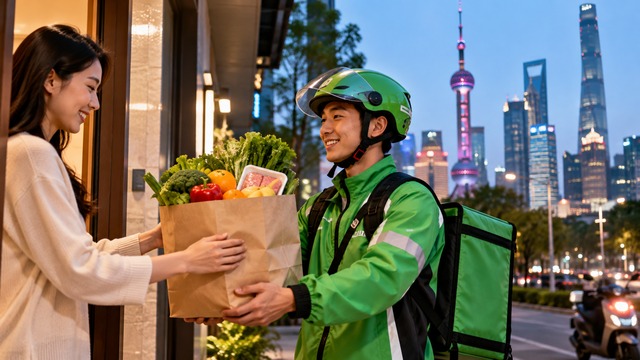
Quick Commerce in China is transforming grocery shopping. Consumers no longer necessarily need to visit a supermarket or schedule a delivery for tomorrow. Increasingly, they can order groceries and receive them in approximately 30 minutes.
Need fresh vegetables for dinner? Running out of milk? Forgot an ingredient halfway through preparing a meal?
In many Chinese cities, consumers can order everyday groceries through their smartphones and receive them in approximately 30 minutes.
What may sound like a premium convenience service elsewhere is becoming an established part of China’s retail ecosystem.
But the real transformation goes far beyond delivery speed. Quick commerce is changing how food products are discovered, stocked, distributed and purchased. And for international food brands, the implications could be significant.
What is Quick Commerce?
Quick commerce, often abbreviated as q-commerce, is a retail model designed to deliver products within a very short time, typically between 10 and 30 minutes in areas where the necessary infrastructure is available.
Unlike traditional e-commerce, which generally relies on centralized warehouses and longer delivery windows, quick commerce brings inventory closer to consumers.
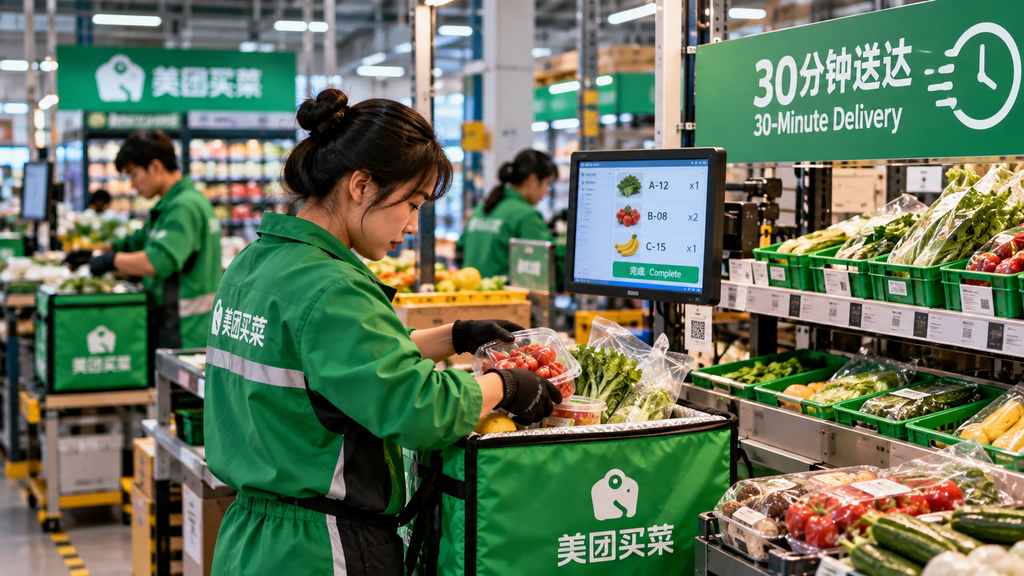
Orders may be fulfilled through nearby supermarkets, convenience stores or dedicated local fulfillment facilities, sometimes known as dark stores.
These facilities are designed for order preparation rather than conventional in-store shopping.
The model combines several elements:
- Localized inventory: Products are stored close to residential and commercial neighborhoods.
- Digital ordering: Consumers purchase through apps and online platforms.
- Real-time stock visibility: Retailers coordinate product availability with incoming orders.
- Rapid fulfillment: Staff prepare orders quickly for local delivery.
- Last-mile logistics: Couriers transport products over relatively short distances.
The result is a shopping experience built around immediate needs rather than planned weekly purchases.
Importantly, 30-minute delivery is not a universal guarantee across China. Availability and delivery times depend on location, product assortment, demand and the retailer’s fulfillment network.
Why Quick Commerce in China is transforming grocery delivery
China’s quick-commerce expansion reflects the convergence of consumer behavior, digital infrastructure and highly developed urban delivery networks.
Mobile payments, app-based shopping and integrated delivery services have helped create an environment in which consumers can move from product discovery to purchase with very little friction.
Platforms such as Meituan, Alibaba’s retail ecosystem and JD.com operate within a competitive landscape where convenience, product availability and delivery efficiency increasingly influence customer choices.
But China’s leadership is not simply a matter of technological sophistication.
It also reflects a fundamental change in how consumers think about grocery shopping.
Traditionally, households might organize purchases around weekly supermarket visits or larger online orders.
Quick commerce introduces a different purchasing occasion: buying something precisely when it is needed.
This is particularly relevant for fresh food, beverages, snacks, meal ingredients and household essentials.
For retailers, the challenge is no longer only to offer the right products at competitive prices.
It is also to make those products available at the exact moment consumers want them.
The numbers behind China’s changing grocery market
The scale of quick-commerce adoption in China illustrates how rapidly shopping expectations are evolving.
According to NielsenIQ’s August 2026 report, The Commerce Revolution: Where East Meets West, 83% of surveyed Chinese consumers use quick commerce.
The comparison with other markets is striking:
| Market | Quick-commerce consumer adoption |
|---|---|
| China | 83% |
| India | 82% |
| Global average | 48% |
| Europe | 34% |
| North America | 3% |
Source: NielsenIQ, August 2026.
These figures measure consumer adoption within NielsenIQ’s research, not the percentage of grocery sales generated through quick-commerce platforms.
Nevertheless, they reveal a substantial difference in how widely the channel is used across markets.
NielsenIQ also reported that China’s quick-commerce market was expected to exceed RMB 1 trillion in 2026, citing market estimates included in its research.
Another indicator comes from China’s official retail statistics.
According to the National Bureau of Statistics of China, online retail sales of food increased by 15.8% year over year between January and September 2026.
Over the same period, total online retail sales of goods increased by 3.8%.
The distinction matters: the 15.8% figure covers online food retail generally, not quick commerce exclusively.
However, it provides useful context for understanding the broader momentum of digital food purchasing in China.
Taken together, these findings suggest that food retail is evolving toward more digitally integrated and convenience-oriented purchasing habits.
How Quick Commerce is reshaping food retail and distribution
The growth of quick commerce has implications for almost every stage of the food supply chain.
1. Product availability becomes a competitive advantage
In conventional retail, a product competes for shelf space. Understanding how retailers select products is equally important, as explored in our article, “Who Decides What Gets on a Supermarket Shelf?”
In quick commerce, it must also compete for availability within a geographically limited delivery network.
A product may be listed on a platform but still be unavailable to consumers outside the fulfillment radius of the stores carrying it.
This makes inventory positioning increasingly important.
For suppliers and distributors, success may depend not only on securing a retail listing but also on ensuring that products are stocked in the right neighborhoods.
2. Assortment decisions become more localized
Consumer preferences are not identical across a city.
Residential neighborhoods, business districts and university areas may generate different purchasing patterns.
Quick-commerce operators can use local demand data to adjust assortments according to the shopping behavior of nearby consumers.
For food brands, this creates opportunities to develop more targeted product selections.
A premium imported snack, for example, may perform differently in a high-income residential district than in a location dominated by convenience-driven purchases.
The relevant question becomes: Which products should be available, where, and for which purchasing occasions?
3. Packaging and product formats matter differently
Quick commerce frequently serves immediate-consumption and small-basket purchasing occasions.
That can create opportunities for products designed around convenience:
- Individual portions and smaller packages
- Ready-to-eat and easy-to-prepare foods
- Beverages and snacks
- Meal components and complementary ingredients
- Products suited to spontaneous purchases
This does not mean that larger grocery baskets are disappearing.
Rather, brands may need to consider how different packaging formats fit different shopping missions.
4. Distribution becomes more complex
Rapid delivery to consumers depends on much more than the final courier journey.
Products must first move through importers, distributors, warehouses and local fulfillment locations.
For imported food products, additional considerations include customs procedures, labeling requirements, product registration where applicable, shelf life and temperature-controlled handling.
A 30-minute delivery promise to the consumer may therefore depend on weeks or months of planning further upstream.
The faster the final delivery, the more important the underlying supply chain becomes.
What this means for international food brands and Italian producers
For international food producers interested in China, quick commerce introduces another dimension to market-entry strategy.
The opportunity is not simply to place products on a new digital platform.
It is to understand whether those products fit the purchasing occasions, distribution economics and consumer expectations associated with rapid delivery.
Consider an Italian food producer exporting pasta, sauces, olive oil or packaged snacks.
Different categories may have very different potential within a quick-commerce environment.
A premium olive oil may remain primarily a planned purchase, while a snack or ready-to-use sauce could be more relevant to an immediate shopping occasion.
These are commercial hypotheses that require testing, not assumptions about what Chinese consumers will necessarily buy.
Several strategic questions become particularly important.
Which purchasing occasion does the product serve?
Is it intended for immediate consumption, meal preparation, replenishment or a more considered premium purchase?
Is the product suitable for local fulfillment?
Shelf life, storage requirements, package size and handling costs can influence whether a product is practical to stock across multiple neighborhood locations.
Who controls distribution and visibility?
Importers, distributors, retailers and digital platforms may play different roles in determining which products reach consumers.
Can the product remain competitive after all costs are included?
Import costs, distribution margins, platform fees, promotions and fulfillment expenses can affect the final economics.
How will success be measured?
Order volume alone is not enough. Brands should also evaluate repeat purchases, profitability, inventory turnover and whether the channel generates genuinely incremental sales.
For Italian producers, the key lesson is that entering a fast-growing market requires more than having an attractive product.
It requires understanding how that market actually operates.
The challenges behind Quick Commerce in China
Despite its growth, quick commerce is not without significant challenges.
The first is profitability.
Rapid delivery requires investment in inventory, technology, order preparation and last-mile logistics.
High order volumes do not automatically translate into sustainable margins.
Competition can also encourage aggressive promotions and discounts, placing pressure on retailers and suppliers.
A second challenge is inventory efficiency.
Maintaining a wide assortment across numerous local fulfillment locations can increase operational complexity, particularly for fresh or temperature-sensitive products.
Food waste, stockouts and forecasting errors can become costly.
A third consideration is the difference between consumer adoption and brand performance.
NielsenIQ’s research emphasizes that strong channel growth does not necessarily guarantee attractive financial returns for participating brands.
This is an important distinction.
A product can sell through a rapidly growing channel without that channel being the most profitable route to market.
For food producers, the decision to participate should therefore be based on category suitability, distribution capabilities and measurable commercial outcomes.
Is China’s Quick-Commerce model the future of global grocery retail?
China provides an important example of how digital infrastructure and changing consumer expectations can reshape grocery retail.
But it would be misleading to assume that every country will follow exactly the same trajectory.
Urban density, labor costs, delivery economics, shopping habits and existing retail infrastructure vary significantly between markets.
The adoption figures reported by NielsenIQ illustrate these differences.
While quick commerce is widely used among surveyed consumers in China and India, adoption remains much lower in Europe and North America.
The lesson for international retailers is therefore not necessarily to reproduce China’s delivery model.
It is to understand the underlying transformation.
Consumers increasingly expect shopping experiences that combine convenience, product availability and digital accessibility.
For some markets, that may mean 30-minute grocery delivery.
For others, it may mean improved same-day services, more efficient local fulfillment or stronger integration between physical stores and online platforms.
The broader trend is toward a retail system in which the boundaries between online shopping, neighborhood stores and delivery services become less distinct.
Conclusion: a new model for global food retail
China’s quick-commerce expansion demonstrates that grocery retail is no longer defined only by where consumers shop.
Increasingly, it is shaped by when they want a product, how quickly they can obtain it and whether retailers can deliver that convenience sustainably.
For food producers, importers and distributors, this transformation raises important questions about product assortment, packaging, inventory positioning and market access.
It also highlights a fundamental commercial reality: understanding consumer demand is only part of the challenge. Businesses must understand the distribution systems that connect their products to that demand.
At Alysei, we believe that following these changes in global food markets is essential for producers and buyers seeking to identify new commercial opportunities.
Because in a rapidly evolving food industry, understanding how markets are changing is the first step toward making better business decisions.
Sources and Further Reading
- NielsenIQ — 83% of Chinese Consumers Use Quick Commerce, Offering a Glimpse into Grocery’s Future (August 2026)
- National Bureau of Statistics of China — Total Retail Sales of Consumer Goods, January–September 2026 (October 2026)
- NielsenIQ — China’s Commerce Innovation Is Reshaping Global Retail (August 2026)