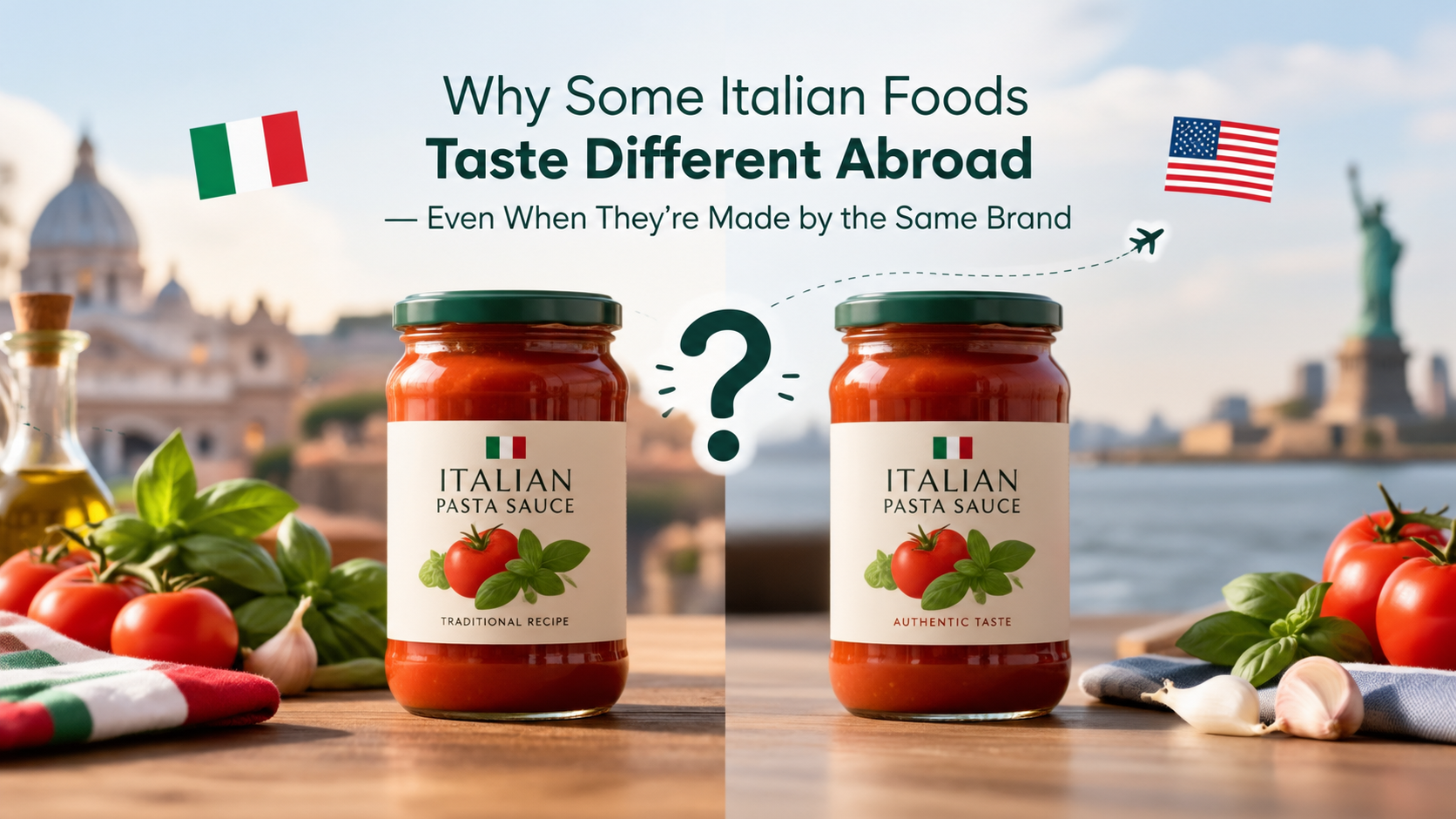
You buy one of your favorite Italian products abroad.
Same brand. Same logo. Maybe even almost identical packaging.
You open it, take the first bite and think:
Wait… why does this taste different?
If you’ve ever had this feeling, you may not be imagining it.
Food products sold under the same brand can sometimes have different recipes or characteristics depending on the country where they are sold.
In fact, the phenomenon is common enough to have a name: dual food quality.
So why does it happen?
Same brand doesn’t always mean same recipe
Food companies operating internationally don’t necessarily use one identical recipe for every market.
There can be several reasons.
Different countries have different regulations regarding ingredients, additives, nutritional requirements and labeling. A formulation that works perfectly in one market may therefore need to be adjusted before the same product can be sold somewhere else.
But regulation is only part of the story.
Your taste has a passport too
What tastes “normal” isn’t necessarily universal.
Consumers grow up with different levels of sweetness, saltiness, acidity, spice and even different expectations about texture.
A flavor considered perfectly balanced in Italy might be perceived differently by consumers in another country.
That’s why food manufacturers may adapt recipes to local preferences. A product can become slightly sweeter, less bitter, creamier, crunchier or simply different enough to better match what consumers in that market expect.
And here’s the interesting part: after years of eating the original version, even a relatively small change may be immediately noticeable.
Then there’s the journey
An Italian product eaten in Italy and an Italian product sold thousands of miles away don’t necessarily have the same journey before reaching the consumer.
Export means considering transportation, storage conditions, shelf life and packaging.
Products destined for international markets may need to remain stable for longer periods or travel through very different distribution chains.
Packaging technology, preservation methods and production choices can therefore also influence the final experience of a product.
Sometimes what changes isn’t simply the recipe, but everything that happens between production and that first bite.
It’s not necessarily about “Better” or “Worse”
This is where things become particularly interesting.
A different formulation doesn’t automatically mean a lower-quality product.
It may simply be a product designed for a different market.
The European Commission has even investigated the phenomenon of branded foods sold in different countries with identical or very similar packaging but different compositions.
So the next time someone insists that their favorite product “just tastes better in Italy,” there may actually be something behind that impression.
But there could also be another explanation.
Sometimes…it’s us
Taste isn’t experienced in a laboratory.
Think about drinking an espresso at a café in Rome and drinking the same coffee at your kitchen table on a rainy Tuesday morning.
Technically, the product might be identical.
The experience isn’t.
Smell, temperature, freshness, atmosphere, memories and expectations all influence how we perceive flavor.
That jar of pesto brought home from Liguria may somehow taste extraordinary while you’re on vacation—and a little less magical three months later at home.
The recipe didn’t necessarily change.
The context did.
What this means for the food industry
Behind this seemingly simple curiosity lies an important lesson for international food businesses.
Exporting a food product isn’t just about shipping the same item to another country.
Companies need to understand local regulations, consumer expectations, distribution systems, shelf-life requirements and market positioning—while deciding how much of the product’s original identity should remain untouched.
For Italian producers in particular, that’s a delicate balance.
Adapting to an international market can be important.
But so is preserving the characteristics that made consumers want an Italian product in the first place.
And for buyers, understanding those differences is part of choosing the right product—and the right producer—for their market.
So, next time an Italian product tastes slightly different abroad, take a look at the label.
You might discover that it’s not your imagination after all.
Same logo. Same brand. Different market. And sometimes, a slightly different taste.