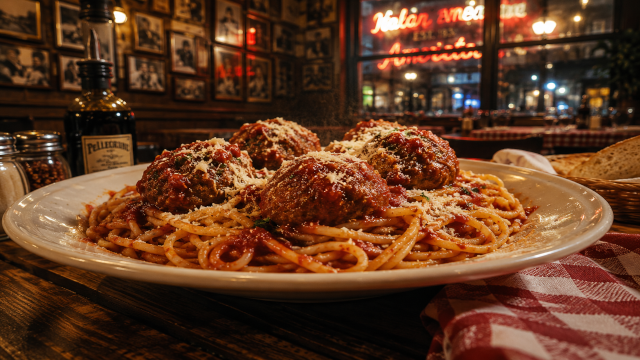
If you walk into an Italian restaurant in the United States, you will almost always find a famous classic on the menu: spaghetti with meatballs. A big plate of spaghetti with tomato sauce, topped with giant meatballs, extra sauce, and plenty of parmesan cheese.
The funny thing is: in Italy, this dish basically does not exist.
So why did it become one of the symbols of Italian food in America? The answer tells a story about immigration, poverty, cultural adaptation, and the evolution of cuisine.
Meatballs do exist in Italy
First of all, an important clarification:
Italians absolutely do eat meatballs.
But traditionally, meatballs are served:
- as a main course,
- in soup,
- fried,
- with sauce,
- or alongside vegetables and bread.
Pasta is usually served separately.
In traditional Italian cuisine, placing huge meatballs on top of spaghetti would have been considered unusual – even excessive. Italian meatballs are also generally much smaller than the American version.
In some Southern Italian regional dishes, you may find tiny meatballs or pieces of meat mixed into baked pasta or Sunday ragù, but not the iconic American-style plate we know today.
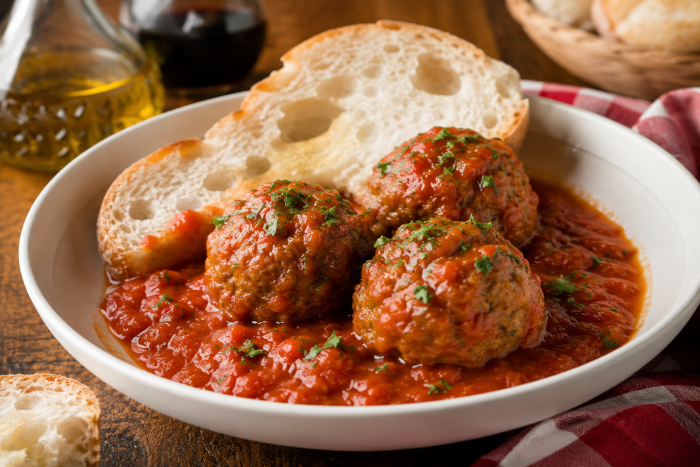
How spaghetti and meatballs became an Italian-American classic
Between the late 1800s and early 1900s, millions of Italians emigrated to the United States, especially from Southern regions such as Campania, Sicily, Calabria, and Abruzzo.
Many immigrants came from extremely poor backgrounds.
In Italy at the time, meat was expensive and considered a luxury:
- meatballs contained very little meat,
- lots of stale bread,
- cheese,
- herbs and fillers.
In America, however, immigrants discovered something completely different:
- meat was cheaper,
- portions were larger,
- ingredients were easier to find.
Naturally, recipes began to change.
As Smithsonian Magazine, Italian immigrants adapted their traditional recipes to the ingredients and greater availability of meat they found in America.
Meatballs became larger and richer in meat. Spaghetti, inexpensive and filling, was combined with meatballs into one generous dish that could feed large families.
This is how Italian-American cuisine was born.
It’s not Italian cuisine – It’s Italian-American cuisine
This is the key point.
Spaghetti with meatballs is not a “fake” dish in a negative sense. It is the authentic result of the Italian immigrant experience in America.
It represents a new cuisine created through the combination of:
- Italian traditions,
- American ingredients,
- local tastes,
- and a love for abundance and comfort food.
The same thing happened with many other famous dishes in the United States:
- Chicken Parmesan,
- creamy Fettuccine Alfredo,
- garlic bread,
- American pepperoni pizza.
Most Italians in Italy rarely eat these foods, yet they have become part of American culinary culture.
Why do Americans associate spaghetti and meatballs with Italy?
There are three main reasons.
1. Italian immigrants made it popular
Italian communities in New York, Boston, Chicago, and Philadelphia spread these recipes through neighborhoods and family restaurants.
2. Hollywood helped turn it into an icon
Movies and cartoons transformed spaghetti and meatballs into a symbol of “Italian culture”:
- Lady and the Tramp,
- mafia movies,
- classic American sitcoms.
The image of a giant steaming plate of spaghetti and meatballs became deeply associated with Italy in the American imagination.
3. It’s perfect comfort food
Carbs, tomato sauce, meat, cheese – it’s rich, simple, satisfying, and emotionally comforting. Americans love it for exactly these reasons.
How is it viewed in Italy?
Usually with curiosity – and often with humor.
Many Italians smile when they see:
- enormous portions of spaghetti,
- giant meatballs,
- lots of sauce,
- heavy cheese toppings.
Because it does not reflect modern traditional Italian cuisine.
But the truth is that spaghetti with meatballs tells an important story: the story of Italian immigrants reinventing their food traditions in a new country.
And in reality, this is how all cuisines evolve over time.
Conclusion
Spaghetti with meatballs is not a traditional Italian dish, but it is one of the most famous symbols of Italian-American cuisine.
It was born from Italian immigration to the United States, from American abundance, and from the desire to preserve cultural roots while adapting to a new life.
It may not be authentically Italian.
But it is authentically Italian-American.
And that is exactly what makes it fascinating.